As an Amazon Associate, we earn from qualifying purchases. Some links may be affiliate links at no extra cost to you. Although our opinions are based on curated research, we haven't used these products. Articles generated with AI.

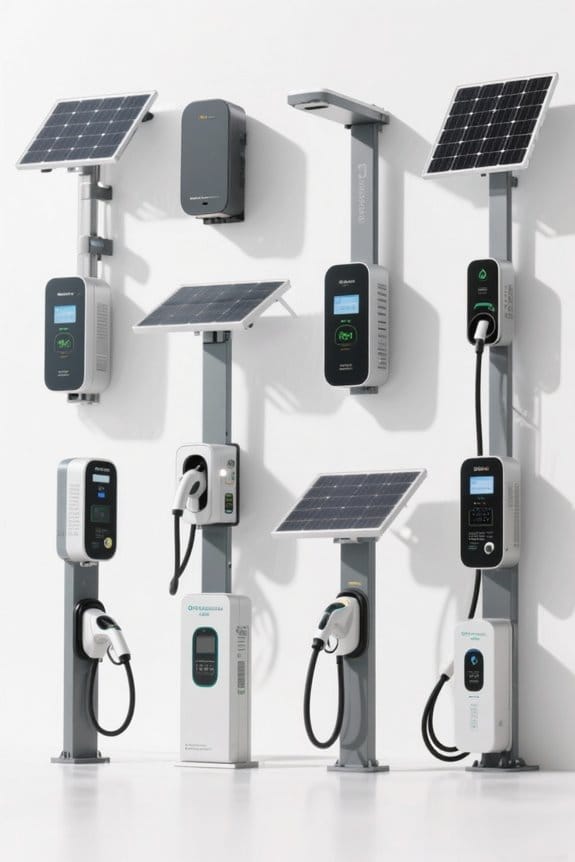
10 Best Commercial EV Charging Stations for Efficient and Sustainable Business Solutions

For efficient and sustainable business solutions, consider these top commercial EV charging stations: ELEGRP Level 2 EV Charger (40 Amp) offers 9.6 kW power, while the LEDVANCE Phase EV Commercial Charger Gen 2 (48 Amp) provides up to 11.5 kW. The 277/480 Volt AC Level 2 Charger (80 Amp) can give 75 miles of range per hour. The Bosch EV3000 DC Fast Charger charges four times faster with a 30 kW output. Keep exploring to find more options and features!
Key Takeaways
- Choose Level 2 EV chargers like the ELEGRP for fast charging rates and flexible installation options to meet diverse business needs.
- Consider high-power charging stations such as the Bosch EV3000 for ultra-fast charging and durability in various weather conditions.
- Ensure chargers are compatible with common EV standards, including the J1772 connector, to accommodate different vehicle types.
- Opt for chargers with smart features like remote monitoring and scheduling capabilities to enhance operational efficiency and user experience.
- Prioritize safety certifications like ETL and UL to guarantee compliance with safety standards, reducing risk for your business.
ELEGRP Level 2 EV Charger (40 Amp)
Sale


ELEGRP Level 2 EV Charger 40Amp, J1772 Portable Electric Car Charger, 240V NEMA 14-50 Plug, ETL...
- Fast & Adjustable Charging: Up to 9.6 kW (37 mph), 7x faster than Level 1, with 5 current levels (16/20/24/32/40A) to match home capacity, plus 1–12H timing delay for...
- Plug & Extended Reach: NEMA 14-50 plug fits 240V outlets for true plug-and-play use, while the 25FT cable offers flexible reach across garages and driveways, eliminating...
- ETL Certified & ELEGRP PBE Protection: Fully ETL certified, ELEGRP’s exclusive PBE technology combines full-link overheat protection with a triple-layer safety system...
If you’re looking for a reliable and efficient charging solution for your electric vehicle (EV) fleet, the ELEGRP Level 2 EV Charger (40 Amp) is an excellent choice. It delivers a fast charging rate of 9.6 kW, providing up to 37 miles of range per hour. You can easily install it using a standard 240V NEMA 14-50 outlet and enjoy the flexibility of a 25-foot charging cable. With five adjustable current levels, you can customize the charging speed. Plus, its advanced safety features protect against surges and overloads, making it a safe and dependable option for a variety of EVs.
Best For: Those seeking a reliable and efficient charging solution for various electric vehicles, including popular brands like Tesla, Nissan, and Hyundai.
Pros:
- Fast charging rate of up to 37 miles of range per hour.
- Flexible installation with a 25-foot charging cable and standard 240V NEMA 14-50 outlet compatibility.
- Enhanced safety features, including PBE and LCR technology, ensuring protection against surges and stable charging.
Cons:
- Requires access to a 240V outlet for installation.
- Heavier upfront investment compared to basic Level 1 chargers.
- May require a J1772-to-NACS adapter for Tesla vehicles, adding to the total cost.
LEDVANCE Phase EV Commercial Charger Gen 2 (Level 2, 48 Amp)
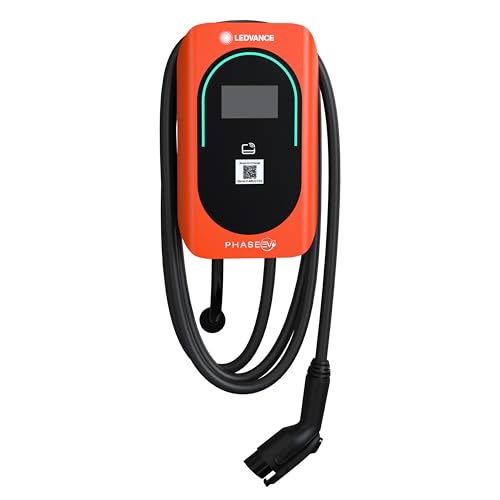
LEDVANCE Phase EV Commercial Charger, Gen 2, Level 2, 48 Amp, 11.5kW, J1772 Charge Gun, 25 ft Cable...
- Lightning-Fast Charging Power – Deliver up to 48 Amps and 11.5kW of power for rapid Level 2 charging—get EVs back on the road faster than ever.
- 4.3" Color LCD Touchscreen – Navigate easily with a vivid, multi-language interface (English, French, Spanish) that puts control and clarity at your fingertips.
- LED Status at a Glance – Stay informed with a large, bright LED indicator for real-time charging status—clearly visible even from a distance.
The LEDVANCE Phase EV Commercial Charger Gen 2 is an ideal solution for businesses looking to provide reliable and efficient electric vehicle (EV) charging options. With a charging capacity of 48 Amps and 11.5 kW, it delivers fast power to nearly all EVs in North America. The 25-foot cable guarantees flexibility during charging, while the rugged design suits various environments.
Featuring a 4.3-inch color LCD touchscreen, it supports multiple languages and displays real-time charging status via a bright LED indicator. Businesses can select wall-mount or pedestal configurations, enhancing accessibility and usability in diverse commercial settings.
Best For: Businesses and property owners seeking to provide efficient EV charging solutions for eco-conscious customers.
Pros:
- Fast charging capability with up to 48 Amps, making it suitable for various electric vehicles.
- Rugged NEMA 4 and IP65-rated enclosure ensures durability in diverse environmental conditions.
- Smart technology features such as WiFi connectivity and optional software integration for enhanced monitoring and analytics.
Cons:
- Higher upfront investment compared to standard chargers, which may be a barrier for some businesses.
- Installation might require professional help, adding to the overall cost.
- Dependence on reliable WiFi or Ethernet for full functionality of smart features might pose challenges in some locations.
277/480 Volt AC Level 2 EV Charger (80 Amp, 30 Feet Cord)
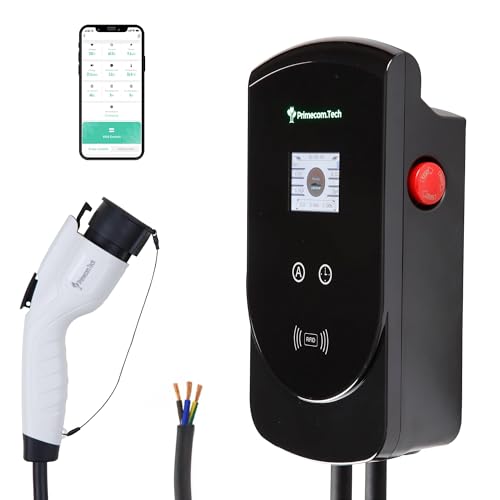
277/480 Volt AC 1 Phase J1772 Level 2 EV Charger 80 Amp with up to 50 Feet Cord Lengths (30 Feet)
- 🛠【 277/480V Easy Multiple Unit Installation 】— No need to use a step-down transformer, you can connect up to 3 High Power Primecom 80 Amp units into one 277/480V...
- ⚡【 HIGH POWER - 80 AMP - UP TO 75 MILES OF RANGE PER HOUR CHARGING 】— Up to 20 times faster than a standard 110V charger, providing up to 75 miles of range with...
- 📱【 SMARTPHONE APP 】— Integrated with smart technology the Primecom level 2 EV Charger can be controlled and monitored via the smartphone app. Schedule charging...
For businesses looking to efficiently charge their electric vehicles, the 277/480 Volt AC Level 2 EV Charger with an 80 Amp capacity offers significant advantages. You can quickly deliver up to 75 miles of range per hour, thanks to its capabilities of providing up to 19.2 kWh. Its 30-foot cord guarantees flexible placement for easy access. This unit supports multiple amperage settings, like 40A and 32A, which accommodates various charging needs. Plus, it connects up to three chargers on a single circuit without needing additional equipment. With smart features like monitoring via a smartphone app, managing your fleet becomes easier than ever.
Best For: Businesses with electric vehicle fleets needing efficient and high-capacity charging solutions.
Pros:
- Supports multiple amperage settings, providing flexibility for various charging needs.
- Can connect up to three units on a single circuit, reducing installation complexity and costs.
- Equipped with smart features for remote monitoring and management via a smartphone app.
Cons:
- Requires a special adapter for Tesla vehicles, which may be an additional cost.
- Relatively high initial investment compared to lower-capacity chargers.
- Customer ratings indicate mixed feedback, which may raise concerns for some users.
Autel Level 2 EV Charger (GEN 2)
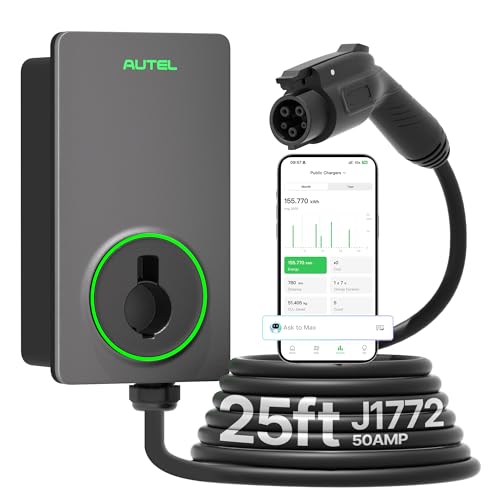
Autel Level 2 EV Charger up to 50Amp, Hardwired,240V, Indoor/Outdoor Fast Electric Vehicle Charging...
- Smart AI Charging: Delivers AI-powered charging based on time-of-use pricing to boost station utilization. Analyzes charging data for actionable insights. Features...
- Rapid Charging: The Level 2 EV Charger is a 240 Volt electric vehicle (EV) charging station that can charge any EV or plug-in hybrid up to 9X faster than a Level...
- Reliable Charging and Theft Protection: Key components undergo full reliability testing with internal temperature monitoring, with a flame-retardant design to 950°C and...
Designed to meet the needs of both residential and commercial users, the Autel Level 2 EV Charger (GEN 2) stands out for its remarkable charging speed and flexibility. This hardwired, 240V charging station operates with up to 50 Amps, allowing customized charging speeds between 6 to 50 amps. With a flexible 25-foot cable, you can easily reach your EV, whether outdoors or indoors. The smart AI charging feature optimizes usage by utilizing time-of-use pricing. Plus, its flame-retardant design guarantees safety in extreme temperatures. The Autel Charge app enhances user experience, enabling you to track and manage your charging effectively.
Best For: Homeowners and businesses looking for a fast, reliable, and smart charging solution for electric vehicles.
Pros:
- Offers charging speeds up to 9 times faster than Level 1 chargers, making it ideal for quick charging.
- Smart AI charging functionality helps optimize costs by utilizing time-of-use pricing.
- User-friendly installation with a flexible 25-foot cable and a dedicated mobile app for efficient charging management.
Cons:
- Hardwired installation may require professional assistance, which could lead to additional costs.
- Limited to indoor/outdoor use and may not suit every location’s infrastructure needs.
- The upfront cost may be higher compared to lower-powered charging options.
ELEGRP Portable EV Charger with 25FT Cable

ELEGRP Level 1/2 EV Charger, 16 Amp, Portable J1772 Charger, 25FT Cable, NEMA 6-20 & 5-15 Adapter...
- 【Reliable Safety with PBE & LRC Tech】Powered by ELEGRP's exclusive PBE technology, this level 2 EV charger provides reliable protection against surges, leakage, and...
- 【Dual Charging Model】Charging speed depends on your outlet type. Use the NEMA 6-20 plug for Level 2 240V fast charging at up to 3.84kWh (11-14 miles/hr). For slower...
- 【Max 25FT Reach &and IP67 Weatherproof Reliability】 Our 25FT portable cable offers the maximum length allowed by NEC safety standards for garage, wall, or outdoor...
With a 25-foot charging cable and adaptable power options, the ELEGRP Portable EV Charger is an excellent choice for those who need flexibility in their electric vehicle charging solutions. This Level 1/2 charger offers 16 amps, accommodating both Battery Electric Vehicles (BEVs) and Plug-in Hybrid Electric Vehicles (PHEVs). You can connect it to standard outlets, operating between 110V to 240V, achieving up to 14 miles of range per hour at 240V. Its durable design, rated IP67 for weather resistance, guarantees reliable performance indoors and outdoors. Plus, with universal compatibility, it supports all J1772 EVs and PHEVs, making it highly versatile.
Best For: Those seeking a versatile and portable charging solution for their electric and hybrid vehicles, both indoors and outdoors.
Pros:
- Universal compatibility with all J1772 EVs and PHEVs, including popular brands like Hyundai, Nissan, and Tesla (with adapter).
- Durable and weather-resistant design with an IP67 rating, suitable for various environmental conditions.
- Flexible charging options that support both Level 1 and Level 2 charging, providing efficient power delivery.
Cons:
- Requires a specific adapter to charge Tesla vehicles, which is not included in the package.
- The 16A charging rate may be slower compared to higher-end chargers with more powerful output.
- Limited operational customer support hours (Mon–Sat, 5 AM–3 PM PT) may not accommodate all users’ needs.
EV Wallbox Charger – Smart Electric Vehicle Charging Station
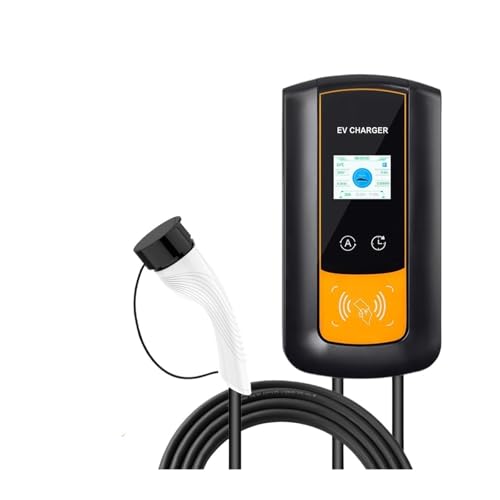
EV Wallbox Charger 7.6kW 11kW 22kW, Type 2 Connector Smart Electric Vehicle Charging Station with...
- Multi-Power Output Options: Supports 7.6kW, 11kW, and 22kW charging levels, providing flexibility to match different electrical installations and vehicle acceptance...
- Smart APP Connectivity: Allows for remote monitoring and control of charging sessions via a smartphone application, offering convenience and detailed energy management.
- Universal Type 2 Connector: Features the standardized Type 2 (IEC 62196-2) plug, ensuring broad compatibility with most modern electric vehicles on the market.
Electric vehicle (EV) owners seeking convenient, efficient charging solutions at home or in a commercial setting will find the EV Wallbox Charger to be an excellent choice. This smart charging station supports various power outputs, including 7.6kW, 11kW, and 22kW, adapting to your needs. It works with both 220V single-phase and 380V three-phase power supplies, making it versatile. The universal Type 2 connector assures compatibility with most modern EVs. You can monitor and control charging sessions remotely via a smartphone app, providing insights into energy usage while optimizing charging speed for safety, making it suitable for any environment.
Best For: Electric vehicle owners who want a flexible and efficient charging solution for both home and commercial use.
Pros:
- Versatile power outputs (7.6kW, 11kW, and 22kW) cater to various charging needs.
- Dual voltage compatibility ensures operation with different electrical systems (220V and 380V).
- Smart APP connectivity allows for remote monitoring and energy management.
Cons:
- Installation requirements may vary depending on existing electrical infrastructure.
- Higher upfront cost compared to basic charging options.
- Dependent on stable internet connection for remote features to function properly.
High-Power EV Charging Station – 400 VDC Fast Charger
For businesses looking to maximize their electric vehicle (EV) charging capabilities, the High-Power EV Charging Station with a 400 VDC output stands out as an exceptional choice. This station delivers a robust 1000A, enabling ultra-fast charging for a variety of electric vehicles. It operates on a three-phase, 480 VAC system, perfect for high-demand commercial applications. Safety is prioritized, as it’s ETL listed and UL 2202 compliant, ensuring reliable usage. Designed without needing ventilation during operation, it provides clear safety
Best For: Businesses and commercial facilities seeking to provide ultra-fast charging options for electric vehicles in high-demand environments.
Pros:
- Fast Charging: Delivers 1000A at 400 VDC, allowing for quick turnarounds for EVs.
- High Demand Capability: Designed to handle three-phase, 480 VAC input, making it ideal for commercial applications.
- Safety Certified: ETL listed and UL 2202 compliant, ensuring safe and reliable operation.
Cons:
- High Initial Investment: The cost of installation and equipment may be significant for some businesses.
- Limited Compatibility: May not be suitable for all electric vehicles, particularly those requiring ventilation during charging.
- Commercial Focus: Primarily designed for commercial use, which may not be necessary for smaller or residential applications.
Bosch EV3000 DC Fast Charger for Commercial and Public Charging
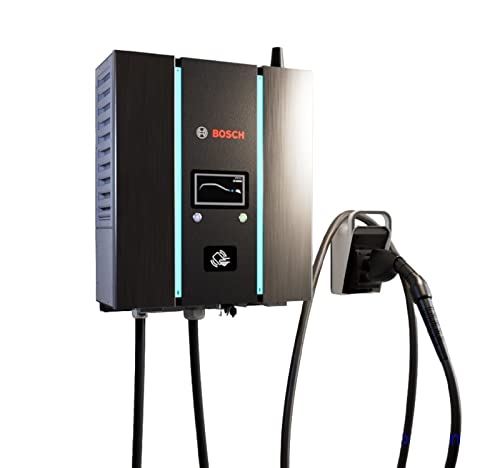
Bosch EV3000 DC Fast Charger for Commercial, Workplace, Fleet, and Public Charging
- The Bosch EV3000 Direct Current (DC) Fast Charger is a 30kW output DC fast charger that is ideal for commercial, workplace, fleet, and public charging, and is compact and...
- DC charging can charge much faster that standard AC charging stations (up to 4X faster) due to their higher power - EV3000 will charge a typical passenger vehicle from...
- The EV3000 is designed to work without the added complexity and cost of a charging network, with its simple 2 button interface, users can plug in and begin to charge...
The Bosch EV3000 DC Fast Charger is an excellent choice for businesses looking to enhance their commercial, workplace, or public charging capabilities. With a robust 30kW output, it can charge vehicles 4X faster than standard AC stations. This means a typical passenger vehicle can go from 20% to 80% charged in just about one hour. Compact and wall-mountable, installation is simplified, reducing both complexity and cost. Its user-friendly two-button interface makes operation easy, while compliance with OCPP protocols allows for flexible private or public charging options. Built for durability, it withstands various weather conditions, ensuring reliable charging for diverse environments.
Best For: Businesses looking to provide fast and efficient charging solutions for commercial, workplace, or public use.
Pros:
- Charges vehicles up to 4X faster than standard AC charging stations, significantly reducing downtime for users.
- Compact and wall-mountable design simplifies installation, saving space and costs.
- User-friendly two-button interface allows for easy plug-and-play operation without complex network configurations.
Cons:
- Pedestal not included, which may require additional purchases for certain installations.
- Limited to SAE J1772 combo connector, potentially restricting compatibility with some vehicle models.
- Initial investment may be higher compared to standard AC chargers, which could be a consideration for budget-conscious businesses.
Splitvolt Level 2 Smart EV Charging Station
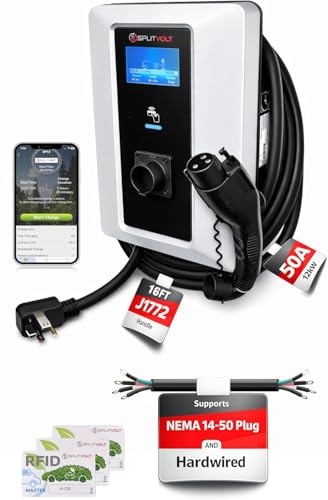
Splitvolt Level 2 Smart EV Charging Station - Connected, Adjustable 12kW, Display, Scheduling, RFID...
- PLUG AND PLAY AND HARDWIRE ALL IN ONE - Plug directly into a household 220v - 240V NEMA 14-50 outlet with 50A circuit for immediate plug and play use (no electrician...
- ULTRA FAST HOME EV CHARGING - This Level 2 EV charger charges up to 12-15 times faster than a 120V outlet, delivering 37-45 mi/hr* depending on if you choose to plug and...
- ADJUSTABLE POWER (8A–50A) & SCHEDULED CHARGING – Take full control of your energy use and savings. Customize your charging speed to match your home’s capacity, from...
Investing in the Splitvolt Level 2 Smart EV Charging Station proves ideal for commercial environments that require efficient and effective charging solutions. This station charges EVs 12-15 times faster than standard 120V outlets, offering speeds of 37-45 miles per hour. It supports all non-Tesla vehicles with a J1772 connector, while Tesla users need an adapter. You can customize charging speeds from 8A to 50A, optimizing energy use. Its NEMA 3S rating makes it suitable for indoor and outdoor use, and it includes smart features like RFID access control and power sharing. Support from the U.S.-based Splitvolt team is readily available.
Best For: Commercial environments requiring efficient and effective EV charging solutions for non-Tesla vehicles.
Pros:
- Charges EVs 12-15 times faster than standard 120V outlets, providing speeds of 37-45 miles per hour.
- Customizable charging speeds (8A to 50A) help optimize energy usage based on home capacity.
- NEMA 3S rating ensures functionality in varying weather conditions and provides additional safety features.
Cons:
- Tesla vehicles require an additional adapter to use the charging station.
- Installation options may vary, potentially leading to higher initial setup costs.
- Limited to J1772 connector compatibility for non-Tesla EVs, which may not suit all electric vehicle users.
2026 Upgraded Level 1&2 Portable EV Charger
Sale

2026 Upgraded Level 1&2 Portable EV Charger, 8-16Amp Adjustable Current & Timer, 110V–240V, NEMA...
- [2026 INTELLIGENT CHARGING UPGRADE — PRECISION CONTROL MEETS SMART SCHEDULING] After surveying 100K+ U.S. EV owners, the Raylix R&D team found that nearly all drivers...
- [ONE CHARGER, ALL J1772 EVs/PHEVs READY!] Compatible with all SAE J1772 electric vehicles and plug-in hybrids—whether it’s Ford, GM, Nissan, Audi, BMW, Kia, Hyundai...
- [CHARGE 4× FASTER — NO MORE WAITING] In a rush? Our 16A Level 1 & 2 charger delivers charging speeds up to 4× faster than standard 8A Charger Level 1. Whether it's an...

Designed for both residential and flexible charging scenarios, the 2026 Upgraded Level 1&2 Portable EV Charger is an excellent choice for everyday electric vehicle (EV) users. This charger features an adjustable current from 8 to 16 amps, supporting both 110V and 240V outlets. It includes a 21-foot charging cable and is compatible with various EV brands, making it versatile. You can optimize charging by selecting from four current levels and using the smart delay timer for overnight charging. Safety is paramount, with over 100,000 safety tests conducted, ensuring reliable performance. Plus, customer support is available within six hours for assistance.
Best For: Everyday electric vehicle (EV) users looking for a versatile and efficient charging solution for home and travel.
Pros:
- Adjustable current settings: Offers four levels of charging (8A, 10A, 12A, 16A) for optimized charging speed based on individual needs.
- Widespread compatibility: Works with various EV brands and supports both Level 1 and Level 2 charging, making it versatile for different situations.
- Enhanced safety features: Undergoes extensive safety testing with protections against overheating, overvoltage, and overcurrent.
Cons:
- Long charging time at lower settings: Charging at 8A may take longer compared to faster chargers.
- Limited range on Level 1: Charging using a standard 120V outlet provides fewer miles added per hour compared to Level 2 charging.
- Size and portability: While portable, the 21-foot cable may be cumbersome for some users when charging in tight spaces.
Factors to Consider When Choosing Commercial EV Charging
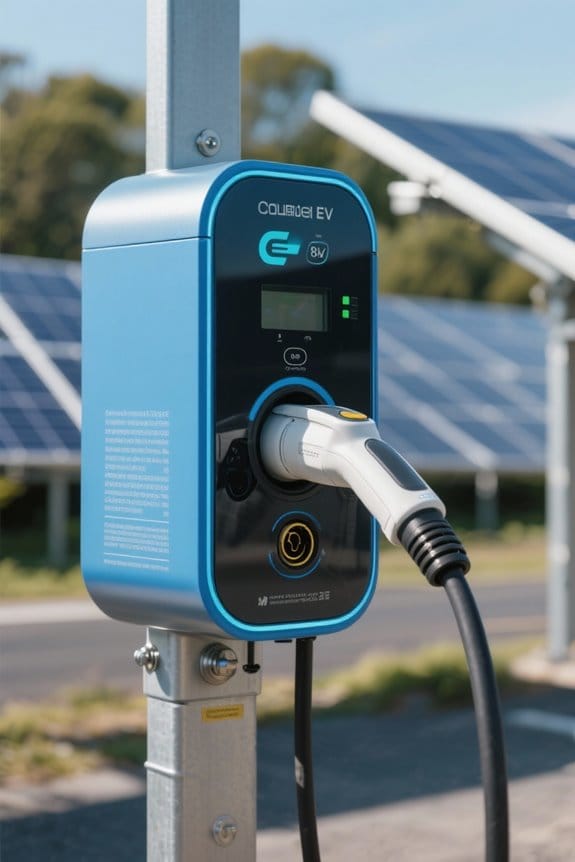
When you’re choosing commercial EV charging stations, several key factors come into play. Consider charging speed requirements, as faster chargers can reduce downtime for your customers, while installation options can vary greatly based on your location and space. Additionally, verify connector compatibility for different vehicle types, prioritize safety certifications, and explore smart features for potential future upgrades.
Charging Speed Requirements
Choosing the right charging speed for your commercial EV charging stations is essential for maximizing efficiency and customer satisfaction. Charging speed is measured in kilowatts (kW), typically ranging from 3.7 kW to 22 kW for Level 2 chargers. Fast chargers can restore up to 75 miles of range per hour, reducing wait times in high-traffic areas. Many commercial chargers provide adjustable amperage settings, allowing you to optimize from 16A to 80A based on your electrical infrastructure and vehicle needs. Incorporating smart technology for scheduled charging during off-peak hours can also enhance efficiency and lower costs. Prioritizing faster charging options helps increase turnover rates at your stations, boosting both customer retention and operational effectiveness.
Installation Options Available
Multiple installation options are available for commercial EV charging stations, allowing you to tailor setups to your specific needs and site conditions. You can choose from wall-mounted, pedestal, or dual charger configurations, depending on space and usage demands. Some chargers offer easy plug-and-play installation, while others may need professional hardwiring for higher amperage. Look for chargers that integrate smoothly into your existing electrical systems, ensuring scalability for future expansions. Additionally, consider options with load balancing to enable multiple chargers to work on the same circuit without overloading. Finally, assess the environmental ratings, such as NEMA 4 or IP65, for durability against outdoor conditions, ensuring your investment lasts and performs efficiently in various climates.
Connector Compatibility Factors
Selecting the right EV charging station involves considering connector compatibility, as it directly affects how well your station meets the needs of various electric vehicle (EV) users. First, confirm your station supports the J1772 connector, standard for most electric vehicles. This compatibility broadens your service to a range of brands and models. If you plan to accommodate Tesla vehicles, remember that they might require an adapter for J1772 compatibility. Additionally, consider stations that support multiple connector types to cater to diverse customer needs. Verify that your charger works with appropriate voltage levels, such as 240V for Level 2 charging. Finally, assess how adaptable the station is to future charging technologies and connector standards as the EV landscape evolves.
Safety Certifications Importance
When considering commercial EV charging stations, understanding the significance of safety certifications can greatly impact your choice. Certifications like ETL and UL indicate that a station meets rigorous safety standards through thorough testing for electrical and fire safety. These certifications help guarantee reliable operation, reducing risks such as electrical surges and overheating. Devices with recognized certifications often include essential safety features like surge protection, leakage detection, and overload safeguards, enhancing user protection. Choosing certified equipment not only increases operational security but may also improve your eligibility for insurance coverage. In some commercial locations, safety certifications are necessary for installation, so confirming compliance with local regulations is crucial to your decision-making process.
Smart Features Integration
How can smart features enhance the functionality of commercial EV charging stations? Smart features, like built-in WiFi and Ethernet connectivity, enable remote monitoring. This allows you to manage charging sessions efficiently. Advanced software can track revenue, balance power loads, and provide real-time analytics, which helps optimize resources. Smartphone apps let users schedule charging and receive notifications, ensuring effortless management. You’ll also benefit from chargers that support OCPP, which improves compatibility with various networks. Additionally, RFID access control streamlines user authentication, while power-sharing capabilities enable simultaneous charging for multiple vehicles. These features not only boost customer satisfaction but also enhance operational efficiency, making your charging station more effective in supporting both business and environmental goals.
Power Management Capabilities
Smart features can lay the groundwork for effective power management capabilities in commercial EV charging stations, allowing you to make informed decisions about energy use. You can customize charging speeds from 8A to 80A, tailoring energy consumption to your site’s infrastructure and vehicle needs. Scheduling charging during off-peak hours can help you save on electricity costs. Advanced power-sharing technology enables multiple EVs to charge from a single circuit without causing overload, maximizing availability. Real-time monitoring through integrated WiFi or Ethernet lets you track energy usage for improved efficiency. Additionally, support for the Open Charge Point Protocol (OCPP) allows for seamless integration into smart networks, ensuring better load balancing among multiple chargers. These capabilities optimize both performance and sustainability.
Durability and Weather Resistance
Choosing a commercial EV charger demands careful consideration of durability and weather resistance, as these factors directly impact its performance and longevity. Look for enclosures with ratings like NEMA 4 or IP65, making sure they’re weatherproof against rain, snow, and dust. A reliable charger should operate efficiently within a temperature range of -31°F to 131°F, handling various environmental conditions. Additionally, focus on features like impact resistance and corrosion resistance, which enhance longevity and minimize maintenance needs. Verify charging cables and connectors meet high-frequency usage standards, with testing indicating thousands of plug-in cycles without failure. Finally, opt for chargers with safety certifications, such as UL or CE, to guarantee safe outdoor operation amid environmental challenges.
Maintenance and Support Services
Investing in reliable commercial EV charging stations goes beyond durability and weather resistance; the effectiveness of these chargers greatly relies on their maintenance and support services. Regular maintenance is essential for longevity and peak performance, which includes checking connections, updating software, and cleaning components. It’s key to have responsive support services to quickly address technical issues, minimizing downtime and enhancing customer satisfaction. Look for warranties that cover parts and labor to protect against unexpected repair costs. Opting for chargers with extensive customer support will aid in troubleshooting and installation. Additionally, engaging service providers that monitor performance metrics can enhance energy usage and guarantee compliance with local regulations and incentive programs.
Frequently Asked Questions
What Is the Average Installation Cost for Commercial EV Chargers?
The average installation cost for commercial EV chargers typically ranges from $2,000 to $10,000 per unit. This price varies based on several factors, like the charger type, electrical infrastructure, and labor costs. For instance, Level 2 chargers are usually less expensive than DC fast chargers. Additionally, you’ll need to take into account potential upgrades to your electrical system, which can increase overall costs but enhance efficiency and user experience.
How Do I Ensure My Business Complies With EV Charging Regulations?
To guarantee your business complies with EV charging regulations, start by researching local laws and guidelines. Each area may have specific requirements regarding charger types and installation. Next, obtain necessary permits, which can vary from state to state. Regularly consult the National Electric Code for safety standards. Additionally, consider joining networks like the Electric Vehicle Infrastructure Training Program for updates and resources. Stay informed and proactive to maintain compliance easily.
Are There Any Government Incentives for Installing EV Charging Stations?
Yes, there are several government incentives for installing EV charging stations. You might qualify for federal tax credits, which can cover up to 30% of your installation costs. Additionally, some states and local governments offer rebates or grants to support clean energy initiatives. Check programs like the Alternative Fuel Infrastructure Tax Credit for updates. Research local resources to maximize your benefits. Utilizing these incentives can greatly reduce your upfront investment and promote sustainability.
What Maintenance Is Required for Commercial EV Charging Stations?
You need to perform regular maintenance on commercial EV charging stations to guarantee they operate efficiently. Inspect charging cables and connectors for wear every six months, replacing damaged parts promptly to prevent safety hazards. Clean the station’s exterior monthly to remove dirt and grime. Additionally, update software regularly to enhance performance and security. Finally, conduct an annual professional inspection to identify any underlying issues, ensuring compliance with safety standards and peak functionality.
How Can I Promote My EV Charging Solutions to Customers?
To promote your EV charging solutions, start by clearly highlighting their benefits, like lowering emissions and saving on fuel costs. Use social media, local events, and partnerships with eco-friendly businesses to reach customers. Consider offering incentives, such as discounts for first-time users. Create informative materials or webinars explaining how the charging stations work. Guarantee your website showcases customer testimonials and detailed product features to build trust and encourage interest in your solutions.


