
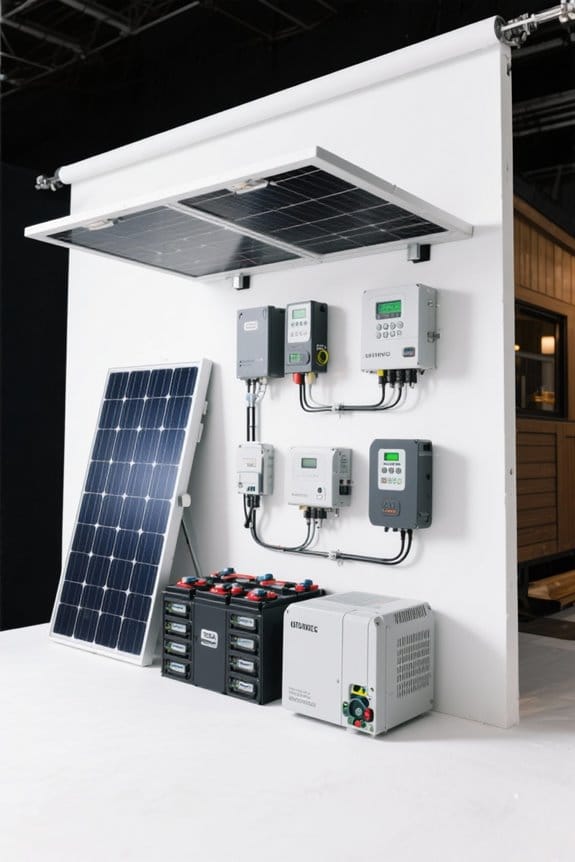

To design a simple off-grid solar system for a tiny house, first calculate daily energy needs by listing appliances and their wattage, including usage hours. Next, choose solar panels with 250W to 300W output, guaranteeing 4-6 hours of sunlight exposure. Select a battery system, preferably lithium, with enough capacity for daily consumption. Use a pure sine wave inverter for appliance compatibility, and install a charge controller for battery protection. Monitoring and maintenance will guarantee peak performance, guiding further insights on effective system management.
Key Takeaways
- Calculate your energy needs by listing all appliances along with their wattage and daily usage to determine total energy consumption.
- Select solar panels based on efficiency and budget, ideally choosing 250W to 300W panels for optimal performance.
- Choose lithium deep-cycle batteries with adequate capacity, ensuring to use a Battery Management System for safety and longevity.
- Install a pure sine wave inverter that matches your power requirements and ensure compatibility with your battery bank’s voltage.
- Wire components correctly and conduct regular system maintenance to ensure optimal performance and early detection of potential issues.
Determine Your Energy Needs
To effectively determine energy needs for a simple off-grid solar system, one must first compile an extensive list of all appliances and devices intended for use. Each item should include its wattage rating and estimated daily usage in hours. For example, a refrigerator may use 100 watts for 24 hours, resulting in 2,400 watt-hours of daily energy consumption. Summing these values reveals total energy requirements. It is crucial to take into account factors like peak usage times and seasonal variations, as they greatly affect total energy needs. Additionally, account for energy losses of around 20% to guarantee adequate solar production and battery storage. Online energy calculators can assist in refining estimates, affirming they reflect realistic energy consumption patterns. Considering the compatibility across EVs ensures that the solar system can efficiently support electric vehicle charging needs as part of the energy consumption plan.
Choose the Right Solar Panels
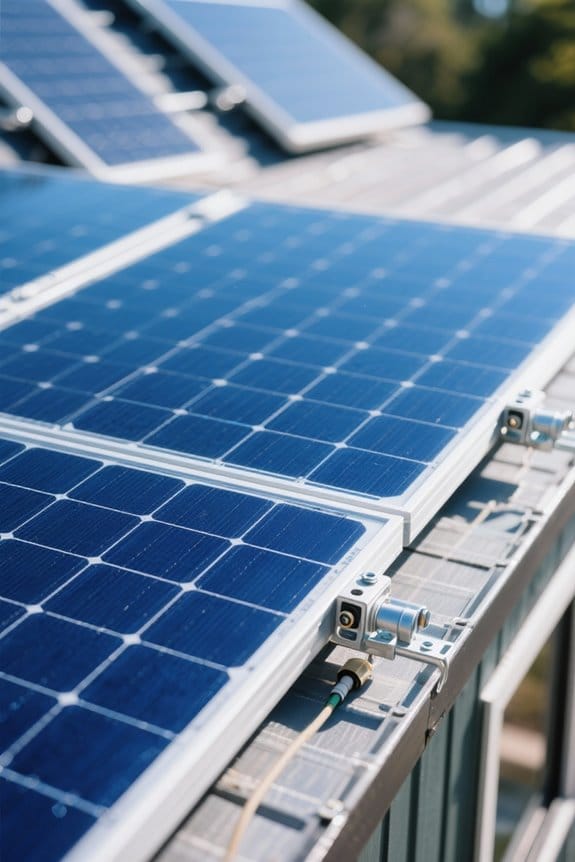
After evaluating energy needs, the next step is selecting the appropriate solar panels for an off-grid solar system. Tiny house owners can choose between monocrystalline panels and polycrystalline panels. Monocrystalline panels offer higher efficiency ratings, making them suitable for limited space. Polycrystalline panels are typically more affordable but may provide lower power output. Aim for solar panels with a power output of 250W to 300W to adequately power tiny house appliances. Additionally, consider the average sunlight exposure in the area, as most panels require 4-6 hours of direct sunlight for ideal performance. Look for units with a strong weather-resistant rating to endure environmental conditions, ensuring long-term functionality and reliability for your solar installation. Advances in MPPT Technology enhance energy capture efficiency, providing up to 99% tracking efficiency, which extends battery life and optimizes performance in varied light conditions.
Select an Appropriate Battery System
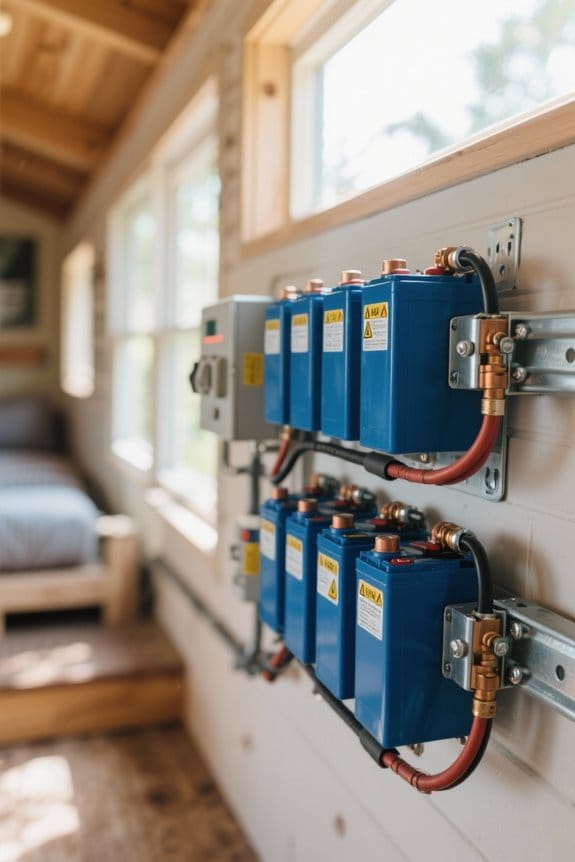
Selecting an appropriate battery system is essential for the efficient operation of an off-grid solar system in a tiny house. Deep-cycle batteries are designed for slow discharge and are more suitable for daily energy needs than standard automotive batteries. Lithium batteries, particularly LiFePO₄, are recommended due to their long lifespan, higher efficiency, and fast charging, despite their higher initial cost. To calculate battery capacity, determine daily energy consumption in watt-hours. Use the formula: Battery Capacity (Wh) = Daily Energy Consumption (Wh) ÷ Depth of Discharge (DOD). A DOD of 50% is standard for lead-acid batteries, while lithium batteries can utilize up to 80-90%. Lithium solar batteries often come with Bluetooth monitoring, allowing users to track performance conveniently through a smartphone app. Finally, guarantee the system includes a Battery Management System (BMS) for monitoring and maintaining efficiency and longevity.
Find the Best Inverter
Determining the best inverter for an off-grid solar system requires careful consideration of several key factors. First, choose a pure sine wave inverter, as it offers cleaner power that is compatible with diverse appliances. Next, assess the inverter’s power rating; for example, if daily power needs total 2,500 watts, a 3,000-watt inverter is advisable to account for power surges. Additionally, make sure the inverter matches the battery bank’s input voltage, typically set at 12V or 24V, for maximum efficiency. It’s also wise to select units with features like automatic voltage regulation and overload protection for safety. Finally, consider inverters with remote monitoring to track energy consumption, enhancing management of your off-grid solar system. MPPT technology can enhance energy output by over 25%, making it an essential feature for maximizing efficiency in off-grid setups.
Set Up a Solar Charge Controller
Setting up a solar charge controller is essential for guaranteeing the safety and efficiency of an off-grid solar system, as it regulates the voltage and current from the solar panels to the batteries. There are two main types of solar charge controllers: PWM (Pulse Width Modulation), which is cost-effective but less efficient, and MPPT (Maximum Power Point Tracking), which optimizes energy output and is recommended for larger setups. When selecting a controller, guarantee it matches the total wattage of the solar array and the system voltage, such as 12V or 24V. To connect, first link the controller to the battery, prioritizing the negative terminal, and then connect the solar panels using appropriate gauge wire to regulate charging and enhance battery life. Advanced charge controller models often include features like dual USB ports and Bluetooth connectivity for remote monitoring, enhancing system efficiency and user convenience.
Wiring and Connecting Components
After establishing a solar charge controller, the next step involves wiring and connecting the various components of the off-grid solar system. Begin by wiring the solar panels in series for increased voltage or in parallel to enhance amperage, ensuring compatibility with the charge controller and battery. Use heavy-duty copper wire for all connections, as it minimizes resistance and promotes efficient power transfer. Connect the charge controller to the battery before linking it to the solar panels, starting with the negative terminal to avoid damage. For the inverter, connect the battery’s positive terminal to the inverter‘s positive with appropriately gauged wire, and attach the negative terminal directly to the battery’s negative post. Secure connections according to proper torque specifications for reliability. Consider using advanced controllers with MPPT technology to enhance battery charging efficiency, ensuring optimal performance of your solar system.
Installation and Mounting Techniques
When installing solar panels, ensuring strong and stable mounting is essential for both performance and safety. Begin by using S5 Solar Feet, securing them to the metal roofing every 4 feet to endure storms. For installation of solar panels, consider arranging them in groups of six, utilizing 250w panels to maximize roof space on a tiny house. Employ IronRidge Slotted L-Foot for rail connections and opt for End Fastening Objects (EFO) to secure the panels, as they provide a more reliable connection than UFOs. Position the panels facing south for peak sunlight exposure, adjusting the tilt when possible. Adjustable angle mounting can enhance energy efficiency by allowing optimal sunlight exposure throughout the day. Finally, make sure all mounting hardware is waterproof, preventing leaks and corrosion, while adhering to safety guidelines throughout the process.
Monitoring and Maintenance Tips
Establishing a routine for monitoring and maintaining a solar system is critical for its long-term efficiency and reliability. Users should regularly clean solar panels to remove dirt, aiming for bi-annual cleaning, or more frequently in dusty areas. Utilizing monitoring apps like Victron GX helps track energy production and consumption, allowing timely adjustments. Battery terminals and connections should be inspected quarterly for corrosion, essential for optimal performance. It is important to check the state of charge (SOC) and depth of discharge (DOD) regularly,—lithium-ion batteries, for example, should not exceed an 80-90% DOD for longevity. Finally, conducting an annual system overview of the inverter and charge controller guarantees all components function properly, identifying potential issues before they escalate. When selecting a battery rack, consider its weight capacity requirements to ensure it can safely support the batteries you intend to use.
Frequently Asked Questions
What Is the Best Solar System for Tiny Homes off the Grid?
The best solar system for off-grid tiny homes includes high-efficiency solar panel types, appropriate energy storage, strategic battery selection, versatile inverter options, thorough system sizing, and careful cost analysis to guarantee sustainability and effective maintenance.
What Is the 33% Rule in Solar Panels?
Much like a gardener overplanting to guarantee a bountiful harvest, the 33% Rule in solar panel design recommends exceeding energy needs by a third, accounting for efficiency losses, thereby optimizing renewable energy sources for off-grid living.
What Size Off-Grid Solar System Is Needed for a Small House?
A tiny house typically needs a 3kW to 5kW off-grid solar system, requiring careful power consumption analysis, adequate solar panel wattage, sufficient battery storage capacity, and inverter selection tips to enhance energy efficiency and guarantee grid independence strategies.
How to Design an Off-Grid Solar System?
To design an off-grid solar system, assess energy consumption, select appropriate solar panels, evaluate battery storage options, compare inverter types, consider installation and maintenance needs, analyze costs, and adhere to regulatory guidelines for maximum environmental benefits.


