
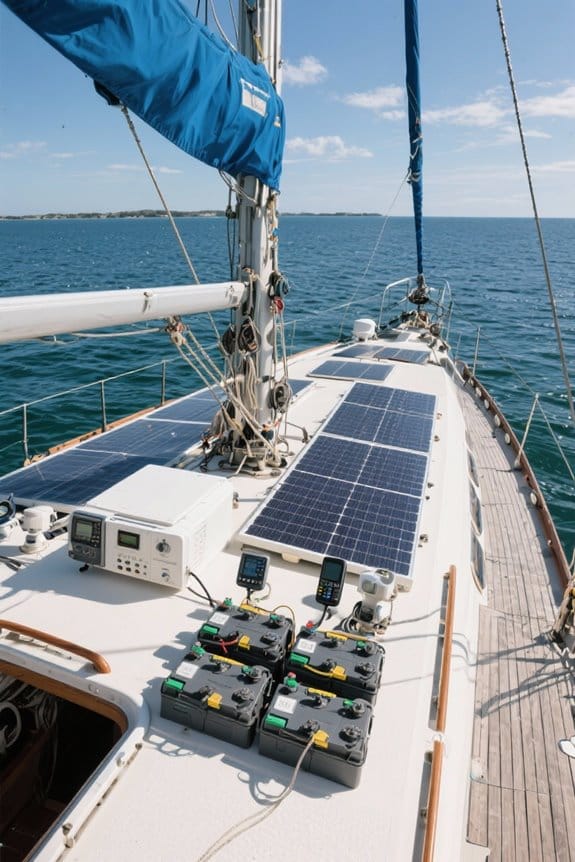

To estimate solar needs for a boat or yacht, start by calculating daily power consumption. List all electrical devices, noting their wattage and hours of use. For example, a device that uses 100 watts for 5 hours consumes 500 watt-hours daily. Assess average sun hours in your area, typically 4-5 hours, to determine necessary panel output. Finally, include battery storage for cloudy days. Proper planning guarantees adequate energy supply, leading to greater efficiency on board. More insights await on optimizing your setup.
Key Takeaways
- Inventory all electrical devices on the boat to calculate total daily watt-hour consumption, factoring in actual usage times.
- Increase calculated energy needs by 25% to accommodate inverter losses and battery inefficiencies for accurate solar panel sizing.
- Evaluate average sun hours for your specific location to determine the minimum solar panel output required for daily power generation.
- Size your battery bank to support 48 hours of usage, considering typical cloudy days and recommended depth of discharge.
- Choose an appropriate charge controller and inverter type based on your solar array capacity and appliance needs for optimal system performance.
Determining Your Daily Power Consumption
Determining daily power consumption is an essential step for anyone operating a boat or yacht, as it directly influences the solar panel system‘s size and efficiency. To calculate your energy needs, create an inventory of all electrical devices, noting their wattage and estimated daily usage in hours. Multiply the wattage of each device by its daily usage to obtain total watt-hours. Next, sum these values to find overall power consumption. Different circumstances, such as travel days versus anchor days, may alter energy demands. It’s vital to factor in inverter losses and battery inefficiencies by adding a buffer of about 25% to the total watt-hours, ensuring an effective solar system. Using panels with high efficiency ratings above 20% can further optimize energy conversion and enhance the overall performance of your solar system. This method will help precisely estimate solar needs.
Assessing Average Sun Hours for Your Sailing Area
Evaluating average sun hours for a sailing area is a significant factor in optimizing a solar power system on a boat or yacht. Locations vary greatly in their average sun hours, with Miami enjoying around 5.62 hours, while Boston only sees about 3.89 hours. These hours typically increase in the summer months due to longer daylight periods and higher sun angles, enhancing solar panel efficiency. Using insolation maps can help sailors assess these average sun hours, guiding them in understanding their solar energy options. The most effective sunlight for generating solar energy occurs between 9:00 a.m. and 3:00 p.m. Consequently, recognizing these factors is essential for accurately estimating solar panel power output based on local conditions and available sunlight. MPPT charge controllers, known for optimizing solar power systems, can further enhance energy efficiency by managing energy under varying conditions.
Calculating Required Solar Panel Output
Calculating the required solar panel output for a boat or yacht involves several straightforward steps that can greatly enhance energy efficiency at sea. First, determine the total daily energy consumption by multiplying the wattage of each device by its usage hours, then sum these figures to get the total in watt-hours. To account for real-world conditions, increase this total by 25%. Next, identify the average sun hours available in your cruising area; this typically ranges from 4-5 hours in the USA. Finally, divide the adjusted daily energy needs by the peak sun hours to find the minimum solar panel output required. For instance, needing 1,250 watt-hours with 5 sun hours necessitates at least a 250 W marine solar panel array. Consider evaluating flexible solar panels for boats, as they offer adaptability to various surfaces and ease of installation, much like the options available for RVs.
Understanding Seasonal Variations in Solar Energy
How do seasonal variations influence solar energy generation on boats and yachts? Seasonal changes can greatly affect energy use, as average insolation, or sunlight received daily, varies from 3-4 hours during winter in northern climates to 5-6 hours in summer. This reduction often necessitates resizing the solar array to guarantee the boat remains energy independent. Additionally, the sun’s lower angle in winter and increased cloud cover can reduce solar panel efficiency by 20-30%. Local weather patterns, including frequent storms or cloudy days, also impact energy generation. To effectively manage these challenges, a thorough power management strategy should be employed, considering auxiliary power sources or larger battery banks to support essential electrical devices when solar energy is limited. High current ratings in solar busbars facilitate effective load handling, which can be particularly beneficial during winter when energy generation is reduced.
Considering Battery Storage for Cloudy Days
When considering battery storage for cloudy days, it is essential to guarantee that a boat or yacht can maintain power during extended periods of low solar energy generation. It is advisable to size the battery bank to store power for at least 48 hours of usage, ensuring readiness for poor weather. First, calculate total watt-hours required from daily consumption sheets, factoring in peak usage times. Anticipate the number of cloudy days typical for the cruising area, which often ranges from 3 to 14 days, to inform battery capacity decisions. Also, consider the planned depth of discharge (DoD), as a 50% DoD is recommended for lead-acid batteries. Additionally, de-rate battery capacity by 20% for temperatures below 50°F, as colder conditions impact efficiency. When selecting a battery, consider those with a long cycle life to enhance durability and ensure sustained power availability.
Evaluating Solar Panel Efficiency and Types
Evaluating the efficiency and types of solar panels is essential for ensuring ideal energy generation aboard a boat or yacht. Monocrystalline panels offer high efficiency and are space-efficient, making them suitable for limited surface areas, though they are more expensive and less effective in shaded conditions. Conversely, polycrystalline panels are generally more affordable but require more space and yield lower efficiency due to their multiple crystal structures. Additionally, flexible panels provide lightweight alternatives and can mold to curved surfaces, ideal for a marine environment. The durability of these panels is crucial, as they must withstand salt, humidity, and UV radiation. Selecting the right panel type will help optimize the boat’s solar systems and effectively manage the energy budget for electrical power needs. MPPT technology can enhance the charging performance of solar panels on boats, ensuring efficient energy extraction even in varying sunlight conditions.
Sizing Your Solar Panel Array
Determining the right size for a solar panel array is a crucial step in optimizing energy use aboard a boat or yacht. To begin, calculate daily energy needs in watt-hours by multiplying the total wattage of all electrical devices by their average daily usage hours. Next, identify your average peak sun hours, typically ranging from 4 to 5 hours. Utilize the formula: daily energy needs divided by peak sun hours to find the total wattage of solar panels required. To account for potential inefficiencies, consider increasing panel area by about 25%. Marine solar panels often have high efficiency ratings above 20%, which are crucial for maximizing energy generation. For practical installation, select multiple smaller panels, such as 100W each, or a single larger panel, like a 300W, ensuring adequate space for solar charging.
Installation Methods for Solar Panels on Boats
Installing solar panels on boats requires careful consideration of various methods that suit both the vessel’s design and the owner’s needs. Common installation methods include Bimini mounts, which provide shade and support for the solar panels, and deck mounts for a lower profile. Rigid panels are durable but need ample space and secure fixing, while flexible panels can conform to the boat’s curves, adding versatility. For efficiency, panels should be oriented south at a 30-45 degree angle to maximize solar power capture and minimize shading. Connections in parallel are typical, enhancing output amperage without altering system voltage. It is crucial to use strong adhesives or brackets for thin-film panels to guarantee secure fixing, especially considering varying environmental conditions at sea. Additionally, selecting panels with weather resistance ensures longevity and reliability in harsh marine conditions.
Selecting Charge Controllers and Inverters
Choosing the right charge controllers and inverters is essential for optimizing solar energy use on a boat or yacht. Solar charge controllers regulate power from the solar panels, available as PWM (Pulse Width Modulation) for smaller systems or MPPT (Maximum Power Point Tracking) for larger panels, enhancing energy yield by 30%. It is important to match the charge controller’s amperage output to your solar array and guarantee compatibility with your battery bank voltage. Inverters convert direct current (DC) from solar panels to alternating current (AC) for appliances. Options include pure sine wave and modified sine wave types, depending on appliance needs. For system safety, utilize marine-grade components and seal connections to minimize failure risks and assure longevity. Additionally, user-friendly interfaces in advanced models allow for easy adjustments and monitoring, which is crucial for managing energy efficiently on the water.
Optimizing Energy Management on Board
Optimizing energy management on board a boat or yacht demands careful planning and continuous monitoring. First, conduct a detailed power audit of all electrical devices, noting their wattage and daily usage hours. This helps accurately estimate total energy consumption and energy needs. Next, categorize devices into critical and non-critical loads; this prioritization allows for better resource management. Aim for approximately 1 kWh of daily power generation from solar panels, adjusting calculations with a 25% inefficiency factor, based on local peak sun hours. Implement power-saving strategies, such as switching to LED lighting and optimizing high-draw devices. Finally, regularly monitor consumption patterns to adapt to seasonal changes, ensuring sufficient power during extended trips while maintaining efficiency on board. Consider using portable solar battery systems like the Jackery Explorer 300 for additional power support during long voyages.
Frequently Asked Questions
What Is the 10% Rule for Yachts?
The 10% rule for yachts recommends solar energy systems produce 10% of total battery capacity daily. This guideline guarantees efficient power consumption, guides system components, installation process, and maintenance, optimizing energy efficiency and voltage regulation for charging systems.
What Is the 33% Rule in Solar Panels?
“Measure twice, cut once” aptly applies; the 33% Rule in solar panels guides energy consumption calculations, battery capacity estimation, and placement, ensuring effective power generation by considering charging efficiency factors and weather impacts for ideal system integration.
What Is the 20% Rule for Solar Panels?
The 20% Rule for solar panels guarantees accurate solar panel sizing by recommending adjustments to energy consumption estimates, factoring in efficiency factors. This helps optimize battery capacity, charging time, and overall system performance for energy independence.
What Is the 120 Rule for Solar Panels?
The 120 rule for solar panels guarantees solar panel capacity surpasses energy consumption by 20%, factoring in sun exposure and charging efficiency. This approach enhances maintenance best practices and supports proper inverter sizing and voltage regulation systems.


