


To plan a small off-grid solar system for a cabin, first assess daily energy needs by listing all appliances and their watt ratings. Calculate the total watt-hours using their run times. Next, determine battery storage, using deep-cycle batteries for reliable power. Calculate the necessary solar panel size based on daily energy consumption, adding 25% for seasonal adjustments. Choose a suitable charge controller and inverter to regulate power flow. Each step is critical for system efficiency and reliability. Details follow.
Key Takeaways
- Create a detailed load inventory of all appliances and their power ratings to assess daily energy needs.
- Calculate total watt-hours for each appliance and sum them for overall daily energy consumption.
- Determine battery storage requirements based on daily energy consumption to buffer against cloudy days.
- Size solar panels based on total daily watt-hour needs, incorporating a 25% cushion for inefficiencies.
- Select a suitable inverter and charge controller that match your system’s capacity and battery type for optimal performance.
Assess Your Daily Energy Needs
How can individuals effectively determine their energy requirements for a small off-grid solar system? First, they should create a load inventory listing all appliances along with their power ratings in watts and anticipated usage hours. To calculate the total watt-hours for each appliance, they can use the formula: Watt Hours = Power Rating (W) x Run Time (hours). After summing the watt-hours for all appliances, they will find their total daily energy consumption. It is essential to include a safety cushion in this calculation to account for power losses and variations in solar power, particularly during cloudy or winter months. It’s crucial to ensure compatibility with existing systems when choosing components such as micro inverters to maximize efficiency. Finally, individuals should regularly monitor their actual energy usage, allowing for potential adjustments in system capacity to meet their energy needs effectively.
Determine Battery Storage Requirements

Determining battery storage requirements is essential for ensuring a reliable energy supply in a small off-grid solar system. First, assess the daily energy consumption of all cabin appliances to calculate total watt-hours needed each day. For basic lighting, one or two 12-volt deep-cycle batteries typically suffice. However, when using high-load devices like freezers, two to four 6-volt batteries may be necessary to meet energy demands. It is important to select deep-cycle batteries, designed for repeated discharges, avoiding standard car batteries. Additionally, account for temperature variations; colder climates often require greater battery capacity. Finally, design the power systems to provide one or two days of battery storage, creating a buffer for cloudy days or increased energy needs, ensuring efficiency in your off-grid solar system. Considering advanced safety features like Battery Management Systems (BMS) and thermal runaway protection can further enhance the reliability and safety of your energy storage solution.
Calculate Required Solar Panel Size
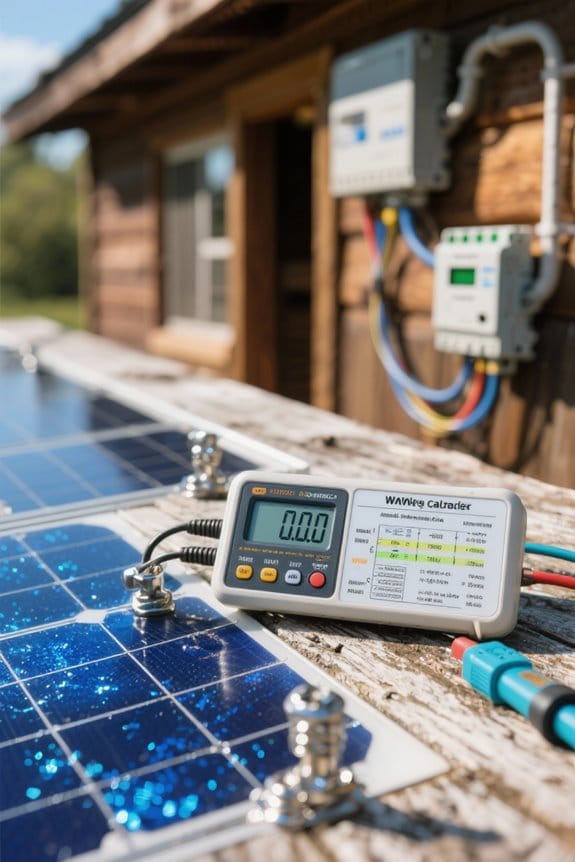
After establishing battery storage requirements, the next step involves calculating the required solar panel size to effectively harness solar energy. To do this, first determine the total daily energy consumption by listing all appliances and their runtimes, then calculate the daily watt-hour requirement. For example, if the total is 800 watt-hours, divide this by a 100-watt solar panel’s average output of 400 watt-hours on a good day, leading to two panels needed. Including a 25% additional cushion for seasonal variations and inefficiencies in the off-grid solar system guarantees reliability. Finally, factor in the overall efficiency of the chosen panels; selecting higher efficiency panels can reduce the number of solar panels needed while enhancing performance, optimizing the battery bank’s charging capabilities. Weather-resistant features are crucial for ensuring the longevity of your solar panels in harsh climates, ultimately contributing to the system’s overall effectiveness.
Select an Appropriate Charge Controller
Selecting an appropriate charge controller is critical to guaranteeing the efficiency and longevity of a small off-grid solar system. Charge controllers regulate the flow of energy from solar panels to batteries, preventing overcharging and extending battery life. There are two primary types: Pulse Width Modulation (PWM) and Maximum Power Point Tracking (MPPT). PWM controllers are ideal for systems with matching battery voltage but are less efficient when solar panel output exceeds battery voltage. MPPT controllers adapt better, maximizing solar energy capture, especially in larger setups. When choosing a charge controller, consider battery type and system design, and verify it matches the total wattage of the solar panels. Regular performance monitoring is essential for maintaining peak functioning. MPPT charge controllers optimize solar power systems, essential for harnessing maximum energy efficiency, and offer advanced tracking efficiencies over 99%, making them an excellent choice for small off-grid systems.
Choose a Suitable Inverter
Choosing an inverter is fundamental for ensuring that a small off-grid solar system functions effectively and meets energy demands. The inverter’s power output must exceed the total wattage of planned electrical loads to prevent overloads and maintain efficiency. Two main types of inverters are available: Pure Sine Wave inverters, which offer peak efficiency and compatibility with sensitive electronics, and Modified Sine Wave inverters, which are more affordable but may not support all devices. It’s important to select a suitable voltage for the inverter, such as 12V, 24V, or 48V, depending on the battery banks used. Additionally, inverters should have safety features like short-circuit and overload protection, while the continuous power rating must include a safety margin of 20-25%. Many models operate quietly, typically under 30dB, which is beneficial for residential use.
Explore Installation Options and Costs
Installation options and costs play a significant role in determining the overall feasibility of a small off-grid solar system. Typically, the cost of an off-grid solar power system ranges from $3,000 to $7,000. DIY installation can reduce expenses but requires adherence to safety protocols, especially when integrating batteries and solar inverters. Alternatively, professional installation offers compliance with building codes and access to tax incentives, thereby increasing overall investment value. Modular systems allow for phased installation, catering to both DIY enthusiasts and professionals. A combination of DIY planning and professional oversight can optimize design and guarantee safety, making it easier to manage costs effectively while achieving energy independence in an off-grid cabin.
Frequently Asked Questions
How Much Solar Power Is Needed for an Off-Grid Cabin?
As if harnessing the sun like ancient alchemists, one must calculate energy consumption and optimize battery storage. Embrace energy efficiency with proper insulation and solar panel types while adjusting for seasonal variations to achieve off-grid harmony.
What Is the 33% Rule in Solar Panels?
The 33% Rule in solar panels recommends designing systems with 33% greater solar energy output than estimated consumption, improving solar panel efficiency, guiding inverter selection criteria, and optimizing battery storage options while ensuring cost-effective, reliable renewable energy solutions.
How to Install an Off-Grid Solar System Step by Step?
To install an off-grid solar system, prioritize solar panel placement, adhere to regulatory considerations, implement energy efficiency practices, apply system sizing strategies, select an appropriate inverter, guarantee battery maintenance, and consider remote monitoring solutions for peak performance.
How to Power Off-Grid Cabin?
To power an off-grid cabin effectively, one must analyze cabin appliances’ power requirements, utilize solar panels for adequate sunlight exposure, incorporate battery storage for energy independence, and consider renewable resources for sustainable living and reduced environmental impact.


