


Before using a rack mount battery at home, individuals should consider installation space, which requires a sturdy surface and about 19 inches of width. Proper environmental conditions, such as temperatures between 20-25°C and good ventilation, are vital for safe operation. A Battery Management System (BMS) is key for monitoring performance and enhancing safety. Understanding cost versus value is essential, as units can range from $15,000 to over $50,000. Further insights can expand your knowledge of effective usage.
Key Takeaways
- Ensure adequate floor space and ventilation for optimal performance while maintaining recommended ambient temperatures of 20-25°C.
- Utilize a reliable Battery Management System (BMS) to monitor battery health and safety features effectively.
- Familiarize yourself with installation requirements, including proximity to power sources and compliance with safety certifications.
- Conduct regular maintenance checks for connections and terminals to prevent safety hazards and ensure longevity.
- Consider the long-term value and scalability of rack mount batteries compared to traditional systems for your home energy needs.
Understanding Rack Mount Battery Systems
Rack mount battery systems, which are increasingly popular for home energy storage, provide a practical solution for managing power needs. These systems typically incorporate lithium batteries, particularly Lithium Iron Phosphate (LFP) chemistry, known for its enhanced safety and durability. Designed to fit standard 19-inch racks, they enable efficient space utilization and scalability, often exceeding 100 kWh in capacity. This capacity suits larger energy demands, unlike traditional wall-mounted options. The inclusion of a Battery Management System (BMS) enhances charging and discharging, helping prevent overcharging and extending battery life. Furthermore, these rack mount systems offer flexibility in installation orientation, allowing users to configure their setup according to various space constraints, ensuring ideal cooling and accessibility in diverse environments. For optimal performance, it is essential that these systems meet safety certifications to ensure operational safety and compliance with industry standards.
Installation Space Requirements
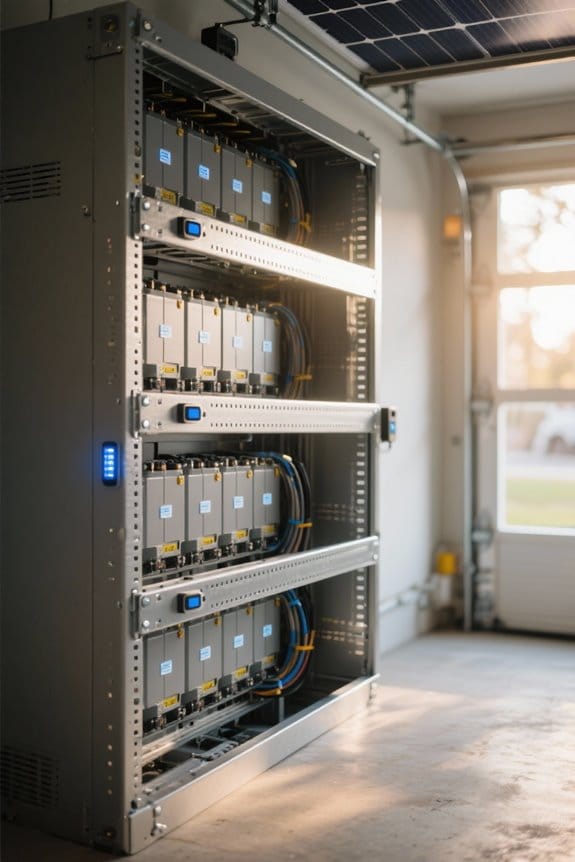
When planning the installation of a rack mount battery system, certain space requirements must be carefully considered to guarantee peak performance and safety. The installation area should provide adequate floor space to accommodate the system’s horizontal design, along with sufficient ceiling height. Clear service pathways are essential for maintenance. These batteries require a sturdy foundation due to their high density, especially when multiple units are installed. Additionally, a well-ventilated location assures ideal ambient temperatures between 20-25°C (68-77°F), which enhances battery longevity and performance. The chosen site must avoid direct sunlight and physical damage to protect battery modules. Proximity to power sources and an efficient battery management system is necessary for reliable operation in industrial applications. It is important to review safety certifications to ensure that the battery system is reliable and adheres to industry standards.
Ideal Environmental Conditions

To guarantee ideal performance and longevity of battery systems, it is vital to maintain perfect environmental conditions. Rack mount batteries should be kept in cool, dry areas with ambient temperatures between 20-25°C (68-77°F). This temperature range minimizes the risk of overheating, which can lead to accelerated chemical degradation. Adequate ventilation is essential, as airflow helps manage heat, thereby preventing overheating. The installation environment must be organized for effective cooling and easy maintenance. Batteries should be shielded from direct sunlight and moisture to prevent electronic damage. Additionally, following proper safety guidelines guarantees that these batteries remain safe and efficient in both residential and commercial spaces. Establishing these conditions optimizes battery performance and extends its lifespan. Furthermore, Lithium-ion batteries are considered cleaner due to their lower environmental impact compared to other battery chemistries.
Safety Measures for Rack Mounted Batteries
Ensuring safety measures for rack-mounted batteries is essential for ideal operation and user protection. First, the batteries should be stored in a location with an ambient temperature of 20-25°C (68-77°F) to optimize performance. A reliable Battery Management System (BMS) is fundamental; it monitors charging and discharging to prevent overcharging and enhances safety. Regular inspections for any signs of physical damage, such as punctures or crush marks, are imperative, as these can lead to safety hazards. Additionally, implementing robust enclosures protects the battery from external impacts, ensuring compliance with local electrical and safety codes. Also, taking advantage of federal tax credits for solar battery investments can make these energy solutions more financially viable. By adhering to these safety protocols, users can minimize risks and maximize the lifespan of their rack-mounted batteries.
Power Protection and Battery Management Systems
Rack mount batteries are increasingly popular for home energy systems, and the role of their Battery Management Systems (BMS) is vital for peak performance and safety. A BMS actively monitors charging cycles, temperature, and individual cell performance to optimize efficiency. Protection strategies within the BMS prevent overcharging and deep discharge, minimizing risks associated with lithium battery failures. For example, a typical rack-mounted battery operates at a standardized voltage of either 48V or 51.2V, which reduces current loss and boosts overall system efficiency. Additionally, the BMS may incorporate active balancing to redistribute energy between cells, further enhancing performance and lifespan. Regular monitoring of the BMS is essential for ensuring reliable power protection in residential applications. Incorporating smart features in solar charge controllers can further optimize energy management and system reliability, providing real-time data monitoring and remote adjustability.
Maintenance Considerations
Regular maintenance is essential for maximizing the lifespan and efficiency of rack mount batteries in home energy systems. Homeowners should routinely inspect connections and terminals for corrosion or wear, as these issues can impede ideal performance and reduce electrical conductivity. Implementing a Battery Management System (BMS) is critical; it monitors temperature, voltage, and charge cycles, playing a key role in the maintenance of battery systems. To guarantee longevity, these systems should be kept in a well-ventilated environment, preventing overheating that can cause early failure. Scheduled software updates for the BMS further enhance functionality and improve safety features, addressing potential performance issues. Additionally, selecting batteries with overcharge protection is important to prevent potential damage and ensure reliable operation. By attending to these maintenance considerations, users can greatly bolster their rack mount batteries’ reliability and efficiency.
Cooling Requirements for Longevity
Maintaining the right temperature for rack mount batteries is essential to prolong their operational life and enhance performance. Ideally, these batteries should be stored in areas with an ambient temperature of 20-25°C (68-77°F). Excessive heat can lead to chemical degradation, considerably reducing longevity. Proper ventilation plays a pivotal role in cooling efficiency by preventing thermal buildup. It is important to protect batteries from direct sunlight and moisture, as these elements can damage battery electronics. Implementing a battery management system with thermal monitoring capabilities can aid in preventing overheating. By ensuring ideal conditions, users can enhance battery performance and lifespan, ultimately leading to more reliable energy storage solutions for home use. Corrosion-resistant materials used in grounding busbars can also be beneficial in protecting battery systems from environmental factors, reducing the risk of damage over time.
Scalability and Expandability Options
Scalability in energy storage solutions is a crucial factor for homeowners looking to adapt to changing energy needs. Rack-mounted systems offer significant scalability, allowing users to start with smaller capacities and expand incrementally. Each module can add over 100 kWh, accommodating future energy demands effectively. These modular designs enable easy replacement of individual components, enhancing long-term usability. Additionally, rack batteries can operate in parallel, allowing seamless integration as energy requirements evolve. This flexibility guarantees that homeowners do not need a complete system overhaul. Compatibility with various inverter systems further standardizes energy storage solutions, making them easier to manage. Enhanced safety features such as fire resistance and waterproof ratings are crucial for reliable operation of rack-mounted systems. Consequently, rack mount batteries represent a practical choice for those seeking efficient and expandable energy storage options.
Cost Analysis and Long-Term Value
When considering the financial aspects of energy storage, one must recognize that rack mount batteries can represent a significant investment. Prices typically range from $15,000 to over $50,000, influenced by energy density and scalability features. However, their long-term value may exceed that of cheaper wall-mounted systems, which cost between $7,000 and $15,000 but lack expandability. Rack mount batteries improve cost per kWh efficiency in larger installations, making them more economical as energy needs grow. Additionally, they offer lower maintenance costs since individual modules can be replaced easily if needed. Lithium-based energy storage systems are preferred for solar installations due to their high efficiency and longevity, which contributes to substantial savings over time. Ultimately, for homeowners anticipating future energy demands, investing in a rack mount battery system could provide substantial savings and enhanced efficiency over time.
Performance During Power Outages
While power outages can disrupt daily life, rack mount batteries offer a reliable solution for homeowners seeking uninterrupted energy supply during emergencies. These systems are designed to meet extensive energy demands, exceeding 100 kWh when expanded, which far surpasses standard wall-mounted systems. The 48V configuration enhances voltage efficiency, reducing current loss and guaranteeing maximum power delivery. This capability is crucial for maintaining essential functions, such as heating, cooling, and medical devices during outages. In addition, the modular design of rack-mounted batteries allows for easy replacement of malfunctioning units, minimizing downtime during power restoration. With advanced safety certifications ensuring compliance with North American standards, homeowners can trust their rack mount batteries to operate safely during power interruptions. This feature ensures that backup power remains available when needed most, providing peace of mind in unpredictable situations.
Common Applications for Rack Mounted Batteries
Rack-mounted batteries serve various applications in home energy systems, expanding their utility beyond just backup power during outages. These battery systems are often employed in supporting home solar energy storage, allowing for efficient energy management. Many homeowners appreciate rack-mounted batteries for their high capacity, which can exceed 100 kWh when fully expanded, making them ideal for energy-intensive environments. They typically operate at 48V to optimize voltage efficiency, reducing current loss and improving performance. Additionally, these batteries can be integrated into smart home energy management systems. This integration enhances energy monitoring and control, enabling users to manage their energy consumption more effectively. With a lifespan exceeding 15 years, these systems are durable, supporting frequent use and high cycle counts.
Comparing Rack Mount Batteries to Other Solutions
In evaluating energy storage options for home use, one must recognize that rack mount batteries provide distinct advantages over their wall-mounted counterparts. These rackmounted batteries typically offer higher capacity options, exceeding 100 kWh, which is ideal for homes with substantial energy needs. Their modular design enhances scalability, allowing homeowners to expand capacity incrementally without significant installation changes. Although the initial cost may be higher, rack mount systems often deliver better long-term value through lower costs per kWh. Additionally, they generally operate at higher voltages, improving efficiency and reducing current loss. Finally, maintenance is usually easier and more cost-effective, as individual modules can be serviced or replaced without needing to replace the entire unit, simplifying upkeep.
Frequently Asked Questions
What Is the 80/20 Rule for Batteries?
The 80/20 rule for batteries specifies maintaining 80% charge for ideal battery lifespan. Adhering to this enhances charging cycles, mitigates temperature effects, and necessitates maintenance tips and safety precautions to guarantee longevity and reliability.
Can a Lithium Battery Catch Fire When Not in Use?
Though lithium batteries are not typically fire-prone when idle, neglecting battery safety can heighten fire risk. Adequate storage precautions and preventive measures, including regular inspections, are essential to guarantee safety, given lithium chemistry vulnerabilities.
How Long Can You Leave a Battery Maintainer on a Battery?
A battery maintainer can be left connected for several months, ensuring ideal charging practices. Regular maintenance tips include checking connections and monitoring battery health, as adherence to usage frequency guidelines enhances lifespan and performance.
What Are the Hazards of Battery Rooms?
In a comedy of errors, battery rooms thrive on improper “ventilation,” acid spills grace the floor, and fire hazards play hide-and-seek—while chemical exposure and poor heat dissipation create the perfect recipe for disaster. Quite the show!


