
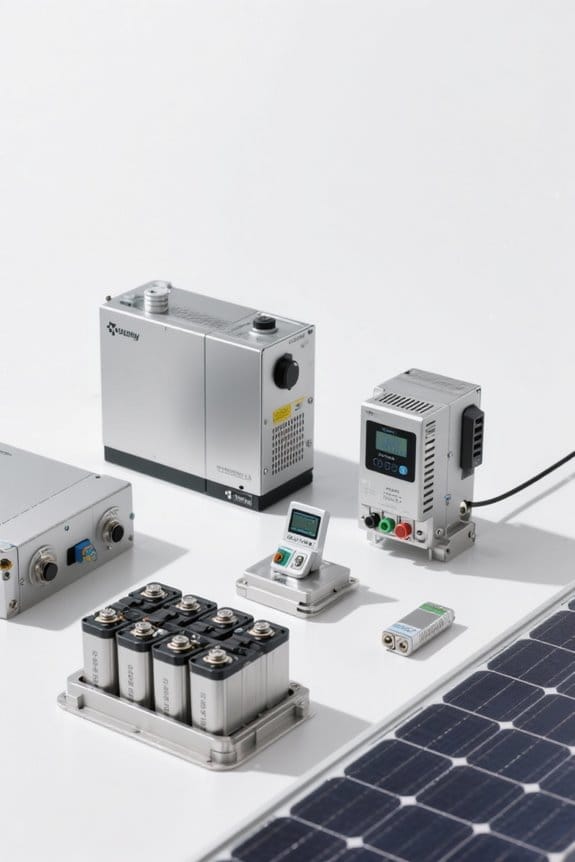

Cycle life indicates how many times a battery can be charged and discharged before it loses capacity. For solar systems, lithium-ion batteries typically last 6,000 to 10,000 cycles, while lead-acid batteries average only 500 to 1,500 cycles. Factors affecting battery degradation include temperature, depth of discharge (DoD), and charging rates. Proper management of these elements is essential for maintaining performance and longevity. Understanding these dynamics can enhance the efficiency of solar energy storage systems and their overall lifespan.
Key Takeaways
- Cycle life determines how many charge/discharge cycles a battery can withstand before capacity diminishes, with lithium-ion batteries lasting significantly longer than lead-acid batteries.
- Lithium Iron Phosphate (LFP) batteries can achieve up to 10,000 cycles, outperforming other types in durability and reduced degradation.
- A deeper depth of discharge (DoD) of up to 80% is safely manageable in Li-ion batteries, enhancing overall energy utilization.
- High temperatures can drastically decrease battery lifespan; maintaining optimal operating temperatures between 20-25°C is crucial for longevity.
- Implementing a quality Battery Management System (BMS) helps monitor and protect against issues of overcharging and excessive discharging, extending battery life.
Understanding Cycle Life in Solar Batteries
How does the cycle life of batteries influence their performance in solar systems? The cycle life refers to the number of complete charge and discharge cycles a battery can undergo before its capacity considerably diminishes. Lithium-ion batteries, particularly Lithium Iron Phosphate (LFP) types, boast a cycle life of 6,000 to 10,000 cycles, greatly exceeding lead-acid batteries with only 500 to 1,500 cycles. This extended cycle life reduces battery degradation over time, allowing lithium-ion batteries to maintain 70-80% of their original capacity. Additionally, they support a higher depth of discharge (DoD) of up to 80%, optimizing energy usage. Effective management of temperature and charging conditions is vital for maximizing their performance and lifespan, helping prevent rapid battery degradation. Lithium solar batteries have a long lifespan, with some models offering up to 15,000 deep cycles, ensuring reliability and consistent performance over time.
Insights From the Preger Study on Lithium-Ion Battery Performance

The Preger study provides significant insights into the performance of lithium-ion batteries, particularly Lithium Iron Phosphate (LFP) types, which are vital for solar energy systems. The study reveals that LFP batteries have the longest cycle life among commercial options, lasting up to 10,000 cycles before facing notable capacity loss. Critically, factors influencing battery degradation rates include temperature variations, depth of discharge (DOD), and discharge speeds. LFP batteries achieve better performance under deeper DOD conditions, allowing discharges of up to 80%. In addition, when compared to other chemistries like Nickel Cobalt Aluminum (NCA) and Nickel Manganese Cobalt (NMC), LFP batteries show lower degradation rates, establishing them as safer and more reliable for solar applications. An important consideration for off-grid living is the choice of battery, where LFP batteries’ longer lifespan and lower degradation rates make them a key component in sustainable and reliable energy storage solutions.
Advantages of Lithium Iron Phosphate (LFP) Batteries

Lithium Iron Phosphate (LFP) batteries offer a range of advantages that make them particularly suitable for solar energy systems. These batteries boast an impressive cycle life, generally lasting between 6,000 to 10,000 cycles, which translates to 15-20 years of reliable service under ideal conditions. LFP batteries have a stable structure that considerably reduces battery degradation compared to other lithium-ion batteries, enhancing their reliability for solar applications. They can handle a depth of discharge of up to 80%, maximizing usable energy capacity. Their thermal stability increases safety by reducing the risk of overheating or fires. While they may have a higher initial cost, LFP batteries often yield lower overall maintenance expenses, making them a wise long-term investment for solar energy users. EconomiPower 48V LiFePO4 battery, for instance, exemplifies this technology in solar setups and RV off-grid systems.
The Role of Depth of Discharge (DoD) in Battery Longevity
Understanding Depth of Discharge (DoD) is crucial for optimizing battery longevity in solar energy systems. DoD refers to the percentage of battery capacity that has been used; for lithium-ion batteries, capacities up to 80% are manageable, while lead-acid batteries should remain below 50% for maximum lifespan. Deeper discharges can cause faster wear on battery components, reducing cycle life and performance. Research shows maintaining a lower DoD can extend battery life greatly, sometimes by several years. For instance, lithium iron phosphate (LFP) batteries are more resilient at deeper discharges compared to nickel manganese cobalt (NMC) or nickel cobalt aluminum (NCA) batteries, making them preferable for solar applications. Hence, effectively managing DoD is crucial for enhancing the efficiency and lifespan of solar storage systems. Additionally, high capacity batteries with robust battery management systems (BMS) and long cycle life ratings can further improve the longevity of solar energy storage solutions.
Temperature Effects on Battery Degradation
Battery performance can be considerably affected by temperature conditions, impacting both efficiency and lifespan in solar energy systems. High temperatures accelerate battery degradation; research shows that battery life can decrease by 50% for every 8°C increase above 25°C. Ideal temperatures for solar batteries typically range from 20-25°C (68-77°F), promoting longevity. Conversely, extreme cold can cause irreversible damage, posing additional risks to battery health. As battery capacity retention may fall to 70-80% after warranty periods, effective thermal management becomes essential. This includes implementing climate-controlled installations and monitoring system temperatures. By addressing temperature effects on battery degradation, users can prolong the usable life of solar battery systems, ensuring improved performance and reliability over time. Additionally, hydrogen fuel cells, with their efficient and durable design, can complement solar systems by providing a sustainable energy source, as they only emit water and have minimal environmental impact.
Impact of Charging and Discharging Rates
When examining the impact of charging and discharging rates on battery longevity, it becomes clear that these rates, known as C-rates, play an important role in determining overall performance. Higher charging rates can lead to increased internal heat, which accelerates battery degradation. For instance, under 3C discharge conditions, lithium-ion batteries may experience a degradation rate of 0.7, causing them to lose capacity more rapidly. While LFP chemistries can handle discharges up to 80% depth of discharge (DoD), excessive discharging leads to diminished discharge capacity. Additionally, temperatures rising above 25°C can double the degradation rate, resulting in a significant reduction in battery life. Therefore, understanding and managing C-rates is crucial for extending the lifespan of solar system batteries. Battery Management Systems (BMS) are essential for protecting batteries from overheating and overcharging, which helps preserve their longevity and performance.
Importance of Battery Management Systems (BMS)
Effective battery management is essential for maximizing the lifespan and performance of energy storage systems in solar applications. Battery Management Systems (BMS) play a critical role in regulating charge and discharge processes. This protects batteries from overcharging and excessive depletion, which can lead to battery degradation. A well-functioning BMS monitors individual cell voltages, controls temperature, and balances cell states. These functions greatly enhance cycle life and efficiency. BMS can also implement intelligent energy management strategies, optimizing charge cycles to stay within recommended Depth of Discharge (DoD) limits—around 50% for lead-acid and up to 80% for lithium-ion batteries. Additionally, high-quality BMS can detect early signs of degradation, improving safety and reliability in solar battery systems. Battery storage solutions can include built-in testers for checking functionality, ensuring batteries are kept in optimal condition for use.
Field Insights on Real-World Battery Performance
Field insights on real-world battery performance reveal significant trends that can greatly affect solar energy systems. Field studies show that lithium-ion batteries, especially Lithium Iron Phosphate (LFP) models, initially degrade by 2-5% in their first year, followed by a slower loss of 1-3% annually from years two to eight. Maintaining a moderate Depth of Discharge (DoD) between 50-80% can remarkably extend battery lifespan, while excessive DoD increases degradation risk. Temperature management is also crucial; even an 8°C rise can halve battery life. Additionally, monitoring system performance and applying firmware updates are essential practices. These insights contribute to understanding the factors that influence battery degradation, helping users make informed decisions for peak solar system performance. A key aspect to consider is the longevity features of advanced battery systems, such as those equipped with robust Battery Management Systems (BMS), which enhance safety and extend the operational lifespan of home solar batteries.
Strategies for Maximizing Battery Lifespan
To maximize the lifespan of lithium-ion batteries in solar systems, users should adopt several key strategies. First, maintaining a moderate state of charge (SoC) between 20% and 80% is vital for prolonging cycle life and minimizing degradation. For instance, while lithium iron phosphate (LFP) batteries allow a depth of discharge (DoD) up to 80%, it is advisable to limit it to lower levels for ideal longevity. Effective thermal management is also important; keeping battery temperatures between 20-25°C can greatly enhance battery life. Furthermore, a quality Battery Management System (BMS) provides essential protections against overcharging and discharging. Finally, engaging in regular firmware updates and performance monitoring can help detect issues early, thereby ensuring timely maintenance and ultimately extending battery lifespan. It is also beneficial to verify voltage capacity for solar applications using a compatible battery voltage monitor to ensure proper management across different batteries.
Future Trends in Solar Battery Technologies
As advancements in technology continue to evolve, the future of solar battery systems is expected to witness significant improvements. Solid-state batteries are anticipated to enhance energy density and safety, potentially outperforming traditional lithium-ion designs. In addition, research into sodium-ion and lithium-sulfur batteries shows promise for lower costs and better environmental sustainability. The integration of energy management systems utilizing artificial intelligence will enhance energy efficiency, predict degradation rates, and extend battery lifespan through real-time data analysis. Innovations in thermal management technologies aim to maintain ideal operating conditions, reducing degradation rates and enhancing reliability. Moreover, hybrid systems that combine solar with other renewable sources could further drive advancements in energy storage technologies, improving the overall cycle life and performance of solar batteries. Solar motion detectors with weatherproof ratings like IP65 or above ensure reliable functionality in various conditions, which is crucial for outdoor solar applications.
Frequently Asked Questions
What Is the Cycle Life of a Solar Battery?
The cycle life of a solar battery typically ranges from 6,000 to 10,000 charging cycles, correlating to a lifespan of 15-20 years, ensuring energy storage efficiency remains relatively high throughout its operational duration.
What Is the 40 80 Rule Battery?
Like a gardener nurturing delicate blooms, the 40/80 Rule promotes battery longevity by encouraging ideal charging habits. Maintaining a state of charge between 40% and 80% improves energy storage efficiency and reduces degradation risks.
What Is the Degradation Rate of Solar Batteries?
The degradation rate of solar batteries influences battery lifespan, typically ranging from 1% to 3% annually. Environmental impact, cycling frequency, and efficiency factors further determine the longevity and performance of these energy storage systems.
How Much Do Solar Panels Degrade After 25 Years?
After 25 years, solar panels typically experience a long-term performance drop, showing efficiency loss of about 10% to 20%. Factors such as environmental impact, including temperature and exposure, considerably influence this degradation rate.


