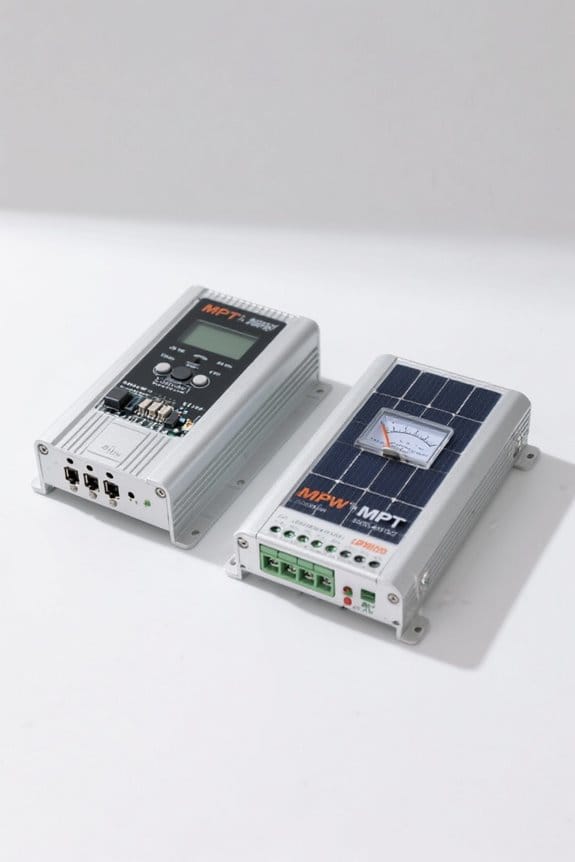
An MPPT (Maximum Power Point Tracking) charge controller optimizes the performance of solar systems by adjusting the voltage and current from solar panels. It continuously tracks the maximum power point, allowing for up to a 30% increase in energy harvested compared to traditional controllers. By converting higher voltages from solar panels to lower battery voltages, MPPT guarantees efficient energy transfer under various weather conditions. Understanding how MPPT functions can enhance solar energy use and effectiveness.
Key Takeaways
- An MPPT charge controller optimizes solar energy output by tracking the maximum power point of solar panels in real-time.
- It converts higher voltage from solar panels to the lower voltage required for charging batteries, enhancing energy transfer.
- MPPT technology can achieve up to a 30% increase in energy harvest compared to traditional PWM charge controllers.
- The controller adapts to varying sunlight conditions, minimizing energy loss during cloudy or rainy weather.
- It improves the overall reliability and lifespan of solar panels and batteries by maximizing energy delivery and reducing losses.
What Is an MPPT Charge Controller?
An MPPT charge controller, or Maximum Power Point Tracking controller, is an essential component in a solar energy system. This electronic device enhances the power output from solar panels by continuously adjusting their electrical operating points. By comparing the voltage and current from the solar panels to the battery’s voltage, the MPPT improves energy transfer with minimal losses. Unlike traditional PWM controllers, MPPT controllers can increase energy harvest by 20-30% under ideal conditions. They convert higher voltage from solar panels to the lower voltage needed for battery charging, making high-voltage solar modules compatible with lower-voltage systems. MPPT technology also improves efficiency in varying environmental conditions, thereby maximizing solar energy capture and enhancing system performance overall. Tracking efficiencies over 99% are now achievable with advanced MPPT technology, ensuring optimal performance and compatibility across various solar and battery configurations.
How Does an MPPT Charge Controller Work?

How does a charge controller optimize energy capture in a solar system? An MPPT charge controller uses the MPPT algorithm to adapt the voltage and current from solar panels, effectively matching the needs of the battery. It continuously tracks the maximum power point of the solar panels, ensuring they deliver the most efficient output power. By allowing solar panels to operate at higher voltage than the battery voltage, it enhances charging efficiency, capturing more energy even under varying sunlight conditions. This capability can boost current to the battery by 20-30% compared to traditional PWM charge controllers. To summarize, an MPPT charge controller maximizes power transfer, ensuring effective harvesting of solar energy for reliable use. Additionally, advanced algorithms used in MPPT controllers help maintain consistent energy supply and robust performance, thereby enhancing the overall efficiency of solar systems.
The Role of Maximum Power Point Tracking in Solar Systems

Maximum Power Point Tracking (MPPT) plays an essential role in enhancing the efficiency of solar energy systems. This technology maximizes the energy output from solar panels by adjusting the voltage and current to capture the maximum power available. MPPT solar charge controllers identify the maximum power point (MPP) on the panels’ I-V curve, which shifts with changing sunlight intensity and temperature. By allowing the use of higher voltage panels to charge lower voltage batteries, MPPT systems can achieve up to 30% higher output compared to traditional controllers. This increased efficiency is particularly beneficial during cloudy or variable weather conditions, helping solar power systems adapt and maintain ideal performance while maximizing energy harvesting from solar arrays. Bluetooth Monitoring in some MPPT controllers allows for real-time system monitoring, enhancing user interaction and system diagnostics.
Comparing MPPT and PWM Solar Charge Controllers
What distinguishes MPPT charge controllers from their PWM counterparts is their fundamental approach to solar energy management. MPPT, or Maximum Power Point Tracking, optimizes both voltage and current, resulting in considerably higher efficiency. In fact, MPPT systems can extract up to 30% more energy from solar panels under fluctuating sunlight conditions compared to PWM systems. MPPT technology maximizes energy extraction, adjusts input voltage for optimal power point, and is suitable for various applications. PWM controllers directly link solar panels to the battery, incurring notable energy losses, especially when panel voltage is much higher than battery voltage. Conversely, MPPT allows the use of higher voltage solar panels with lower voltage batteries, converting excess voltage into usable energy. Although MPPT controllers may involve higher upfront costs, their long-term efficiency advantages can lead to lower overall energy expenses.
Advantages of Using an MPPT Charge Controller
While the initial investment in an MPPT charge controller may be higher than that of a PWM controller, the advantages it offers can greatly enhance solar energy efficiency. An MPPT charge controller maximizes the delivery of voltage and current, enabling a 20-30% increase in energy harvest from solar panels. This technology tracks the maximum power point (MPP), ensuring ideal levels of energy capture and considerably reducing energy loss during conversion. In colder climates, it can capitalize on higher voltage outputs, providing extra energy during peak winter demand. Additionally, by maintaining greater efficiency, fewer solar panels may be required to achieve the same energy output, ultimately leading to long-term savings and a faster return on investment. With advanced algorithms, MPPT controllers further optimize solar energy conversion, ensuring consistently high tracking efficiency of up to 99%.
Enhanced Power Transfer Efficiency
The efficiency of power transfer in a solar system considerably improves with the use of MPPT (Maximum Power Point Tracking) charge controllers. These controllers continuously track the maximum power point, optimizing the voltage-current relationship between solar panels and batteries. By adjusting the output voltage to exceed battery voltage, MPPT controllers enhance energy transfer while reducing losses. This leads to an increase in solar energy conversion efficiency by 20-30% compared to traditional charge controllers. Additionally, in colder climates, higher output voltage can greatly boost energy availability, especially during peak usage. Furthermore, the integration of MPPT technology allows for fewer solar panels, achieving similar energy output, which can result in cost savings for larger installations. In 2026, micro inverters with MPPT technology are expected to significantly boost energy output, maximizing the efficiency of solar power systems.
Adaptability to Weather Conditions
Adaptability in solar energy systems greatly enhances overall performance, particularly under varying weather conditions. MPPT (Maximum Power Point Tracking) charge controllers continuously monitor factors such as temperature and sunlight intensity. This allows them to optimize the current delivered by solar modules, even in less-than-ideal circumstances. For instance, in cooler environments, MPPT technology can utilize higher voltages, sometimes reaching 18V, to improve energy extraction. During cloudy or rainy weather, MPPT controllers adjust in real-time, ensuring that energy loss is minimized. This adaptability can lead to a 20-30% increase in the charge current available to charge a battery compared to traditional systems. Consequently, MPPT technology profoundly improves energy availability and system performance across different weather conditions. MPPT controllers are more efficient than traditional PWM controllers, which enhances overall energy management in solar systems.
Optimal Performance for Larger Solar Systems
In larger solar systems, MPPT (Maximum Power Point Tracking) charge controllers consistently enhance energy output by efficiently extracting power from solar panels, achieving increases of 20-30% compared to traditional PWM (Pulse Width Modulation) controllers. By allowing for the integration of higher voltage solar panels, MPPT systems reduce current draw and minimize energy losses associated with voltage drop over long wiring runs. These controllers continually adjust the voltage and current to adapt to varying environmental conditions, ensuring that the charge to the battery remains ideal. Advanced safety features such as overcurrent and short-circuit protection are critical in maintaining operational integrity. This not only maximizes energy output but also helps extend the lifespan of both solar panels and batteries, resulting in a more reliable energy delivery system. Consequently, MPPT technology enhances the efficiency of larger solar setups considerably.
Return on Investment Considerations for MPPT Controllers
How does the increased efficiency of MPPT charge controllers impact the overall return on investment for solar energy systems? MPPT, or Maximum Power Point Tracking, greatly enhances solar energy efficiency, leading to notable energy savings. Although MPPT systems come with higher upfront expenses compared to traditional PWM controllers, their superior performance can considerably reduce the number of solar panels required for equivalent energy production. Users have reported energy production gains of 20-30%, particularly under variable weather conditions. As a result, while the time to recoup these additional costs through energy savings may vary, the long-term benefits justify the investment. Advanced 16BB technology enhances energy performance, offering additional efficiency gains. Hence, integrating high-quality MPPT controllers like EcoFlow’s can effectively amplify the value of solar power investments through efficient energy management.
When Is MPPT Technology Most Beneficial?
While various factors affect the performance of solar energy systems, MPPT (Maximum Power Point Tracking) technology becomes especially beneficial in certain conditions. In colder climates, PV module voltages increase, allowing MPPT technology to boost energy efficiency by 20-30% compared to traditional systems. Additionally, during partial shading, it manages to extract maximum power from panels exposed to varying sunlight. This capability is essential on cloudy days, where traditional systems may underperform. Furthermore, MPPT charge controllers can notably enhance charging current from the panel, making them particularly effective for battery systems that are deeply discharged. By optimizing voltage and current, MPPT guarantees consistent energy delivery, maximizing the utility of solar systems throughout diverse weather conditions. Many inverters feature built-in monitoring systems, allowing real-time tracking and proactive management of solar output for enhanced performance.
Selecting the Right MPPT Charge Controller for Your Needs
Selecting the right MPPT (Maximum Power Point Tracking) charge controller is vital for optimizing solar energy systems. When making a selection, consider the system voltage requirements, which can be 12V, 24V, or 48V, to guarantee compatibility with your solar panels and batteries. Key specifications like maximum input voltage (Voc) and peak power voltage (Vpm) should match your solar panel output for effective solar charge. A higher wattage rating on the MPPT controller provides flexibility for future expansion. Additionally, the built-in safety features are essential for handling electrical surges and protecting connected components. Finally, assess environmental conditions; a suitable MPPT model can enhance efficiency under varying temperatures and sunlight, guaranteeing the battery will charge effectively in diverse situations.
Frequently Asked Questions
What Is the Purpose of a MPPT Solar Charge Controller?
The purpose of an MPPT solar charge controller centers on charge optimization, enhancing solar efficiency through performance monitoring and voltage regulation. It guarantees effective battery management, improving energy conversion and system compatibility across varying environmental conditions.
Do I Really Need an MPPT Charge Controller?
Considering the cost of energy versus the benefits, an MPPT charge controller enhances solar efficiency through superior charge regulation and energy optimization. Installation tips emphasize compatibility with larger systems, making it a valuable investment for sustainable energy solutions.
What Does MPPT Do When the Battery Is Full?
When the battery is full, MPPT charge controllers manage battery protection through charge regulation, implementing voltage adjustments for ideal battery management. They enhance solar efficiency by redirecting excess energy, ensuring energy optimization and system compatibility without overcharging.
What Are the Disadvantages of a MPPT Solar Charge Controller?
Like a double-edged sword, MPPT solar charge controllers present disadvantages including higher costs, installation challenges, complexity issues, efficiency loss in specific applications, and a limited lifespan, potentially deterring users from opting for this advanced technology.